
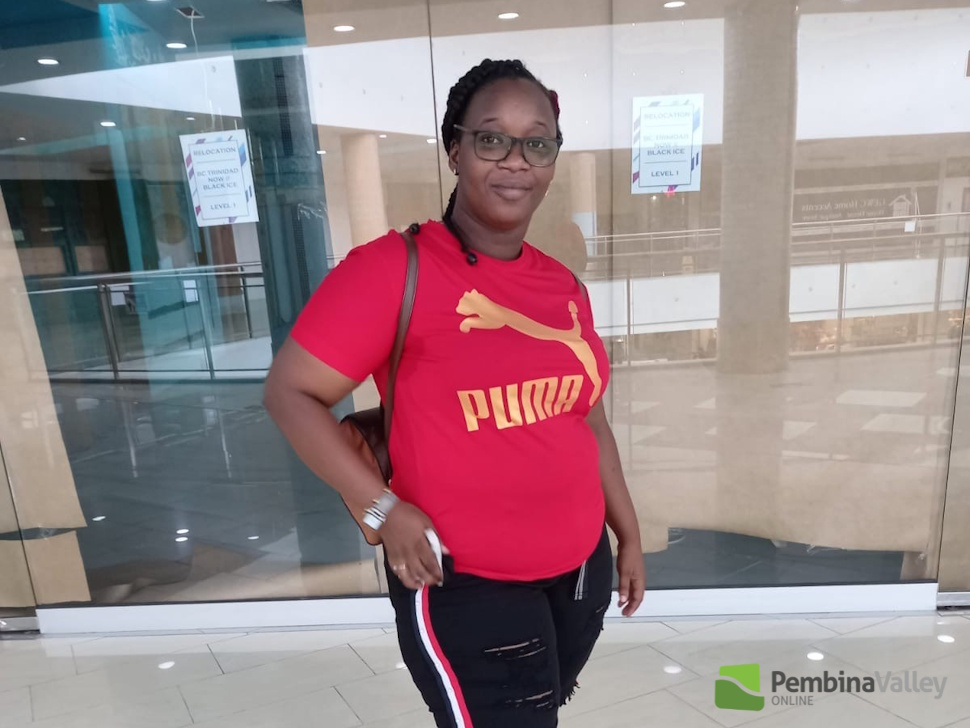
Nesha Hayles, a new resident of Morden, who nearly lost her life to carbon monoxide poisoning. Submitted photo.
For people who have spent their lives in the Pembina Valley, the risks of carbon monoxide poisoning may feel like common knowledge.
An incident in the region this week, however, suggests that for some newcomers — particularly those arriving from warmer climates with open-air homes and garages — the danger posed by the colourless, odourless gas is not well understood.
It’s a knowledge-gap that has arisen in other provinces as well.
For Nesha Hayles, who is originally from Jamaica and later lived in Trinidad and Tobago before moving to Morden last November, not knowing about carbon monoxide risks nearly cost her her life — and her son’s.
“I have a detached garage, and I was … in there because I was feeling cold and I didn’t want to come out into the cold, so I was sitting in the car. It was on,” she said.
“After about half an hour sitting there, my son came and said, ‘Mommy, you’re not coming inside,’ and I said to him, ‘I’m feeling so cold. I don’t want to go out in the cold,’ so he sat there with me, and we were talking about life and what he wants to do here in Canada.”
Hayles said that just that day, she had picked up her son from the airport in Winnipeg after not having seen him for nine years.

Nesha Hayles and her son, who both suffered from carbon monoxide poisoning. Submitted photo.
After about an hour of conversation, however, the pair began to feel tired, and before long, Hayles’ son mentioned that his head was hurting, and Hayles herself noticed that other concerning symptoms were developing.
“When he came out of the car, I said, ‘You’re leaving me?’ and he said, ‘My head is hurting,’ so I came out behind him. When he opened the door, he was saying, ‘Mommy, my chest is pounding so hard,’ and when I got out in the open, [there was so much pressure] in my eardrums.”
Hayles also reported that her eyes felt like they were pulsing.
At this point, the new resident of Morden recognized that something was wrong and immediately drove herself and her son to Boundary Trails Health Centre for care.
That’s where she learned about carbon monoxide poisoning in garages, and she also learned that she and her son were lucky to have survived being exposed to the gas for that amount of time.
“The doctor said to me that … we are fortunate to be alive. That’s the word he used, that we are ‘fortunate’ to be alive,” she said.
“We are grateful to be here.”
In the wake of Hayles’ experience, she now has new information about the risks of leaving a car running in an enclosed garage.
She said that while she knew about carbon monoxide poisoning in the context of using generators indoors during hurricanes back in the Caribbean, she didn’t know that being inside a running vehicle in a garage carries similar risks.
In this, she is not alone.
Last year in Ottawa, a group of ten newcomers from Haiti also suffered from carbon monoxide poisoning due to a vehicle left running in a garage.
In this incident, 44-year-old Patrick Joseph, father of two, was less fortunate than Hayles and her son.
Tragically, he lost his life to the poisoning mere months after starting his new life in Canada.
Hayles’ carbon monoxide scare comes as she adjusts to a new climate and a new country.
She said her island nation doesn’t have the same type of enclosed garages as rural Manitoba.
The result is that Hayles didn’t realize the danger she was in during what was a routine practice for her.
“That is something that I normally do when I reach home. I sit there, but it’s the first time that I [stayed] so long in the car,” she said.
“Maybe if my son [hadn’t been] there, I would have passed out in there because I was feeling tired and sleepy …. If it wasn’t for him, I wouldn’t be here today.”
In response to the carbon monoxide poisoning, Regional Connections Immigrant Services, which works with newcomers in a variety of ways from language instruction to settlement, issued a reminder to its students and clients.
I think anytime that we are dealing with cross-cultural situations, we have to understand that there are many layers to this and that this is a kind of event that could happen to anyone, really.
-Jaime Friesen-Pankratz on Hayles’ carbon monoxide poisoning.
“Nesha articulated very well what happened to her to teacher, and at that point, the teacher then wrote her story out and our language director, Rhoda Keck, sent the story to all the instructors as a reminder that this is a topic that we need to talk about with our students,” said Jaime Friesen-Pankratz, the head language teacher at Regional Connections.
“Especially now that we’re in a super cold weather stretch, right? How many of us want to get into a cold car? None of us. We all warm up our cars, so the e-mail was sent out to instructors as a reminder.”
Friesen-Prankratz added that, through its settlement services, the organization offers winter workshops that cover carbon monoxide poisoning, along with information on preparing for winter and functioning in colder climates.
She added that, in situations like these, it’s important to be aware of context.
“As an organization, we’re always providing our students and our clients with information about winter weather, … but at the same time, I think we can realize that we’re all maybe guilty of making errors when it comes to cold-weather-type situations,” she said.
The doctor says that the carbon monoxide attaches to your cells, so it takes some time for it to leave your system. I’m still feeling tired, having shortness of breath sometimes, and when I’m in an enclosed building, I sometimes get … a feeling of anxiety.
-Nesha Hayles on the aftermath of carbon monoxide poisoning.
“I think it would [also] be really helpful as well for all of us if we’re Canadian-born folks, settler folks, to put ourselves in a position of living in a new country where we might not be familiar with, let’s say, hot weather, and things to do to keep ourselves safe in those situations.
“I think anytime that we are dealing with cross-cultural situations, we have to understand that there are many layers to this and that this is a kind of event that could happen to anyone, really.”
According to the Government of Canada, the threat of carbon monoxide extends across the country.
The page explains that the gas can be produced by gas or oil furnaces, space and water heaters, clothes dryers, ovens, wood stoves, and other household appliances that run on fossil fuels, including wood, gas, oil, or coal.
Inhaling the substance can cause brain damage, suffocation, and death.
Canada recommends installing a carbon monoxide detector on every level of one’s home to ensure safety.
As for Hayles, while the threat has passed, she and her son continue to navigate on-going poisoning symptoms, and on one occasion, she returned to the hospital experiencing shortness of breath.
“The doctor says that the carbon monoxide attaches to your cells, so it takes some time for it to leave your system,” she said.
“I’m still feeling tired, having shortness of breath sometimes, and when I’m in an enclosed building, I sometimes get … a feeling of anxiety.”
She added that she has elected to tell her story because she wants “everyone to be aware of the danger that carbon monoxide can cause.”
Ultimately, she is happy that she and her son emerged from the incident alive.
“I want to see my children grow up. I want to see my grandchildren, so I will never make that mistake again,” she said. “Never.”
To learn more about carbon monoxide poisoning from the Government of Canada, click here.
Regional Connections provides services in multiple communities in rural Manitoba.
Regional Connections has 15 locations throughout Manitoba offering a variety of services.


Additional Programs: